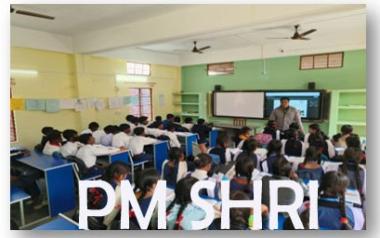
PM SHRI (PM Schools for Rising India) is a Centrally Sponsored Scheme launched by the Government of India in 2022 to strengthen and transform selected existing government schools into model schools that showcase the implementation of the National Education Policy (NEP) 2020. The scheme aims to develop more than 14,500 schools across the country, including schools managed by Central Government, State Governments, Union Territories, local bodies, Kendriya Vidyalayas (KVs), and Jawahar Navodaya Vidyalayas (JNVs).
The objective of PM SHRI is to provide high-quality, inclusive, equitable, and joyful education in a safe and stimulating learning environment. The scheme focuses on strengthening school infrastructure, promoting experiential and competency-based learning, integrating technology in education, enhancing teacher capacity, and fostering 21st-century skills among students. PM SHRI schools are envisioned as exemplar institutions that will mentor and guide neighbouring schools in improving educational outcomes.
The scheme is being implemented for a period of five years from 2022-23 to 2026-27. It emphasizes smart classrooms, modern laboratories, libraries, sports facilities, vocational education, green and sustainable practices, and holistic development of students. More than 20 lakh students are expected to benefit directly from the initiative, while the best practices developed in PM SHRI schools will be scaled up across the school education system.
PM SHRI schools serve as demonstration schools for quality education and play a crucial role in realizing the vision of NEP 2020 by nurturing responsible, productive, and future-ready citizens.
For details, click here to visit the PM SHRI portal
Key Features and Pillars :
• Curriculum & Pedagogy: Focuses on experiential, play-based, and competency-based learning. It includes the introduction of Balvatika for early childhood care.
• Green & Sustainable: Developed as Green Schools using solar energy, rainwater harvesting, waste management, and nutrition gardens.
• Infrastructure & Technology: Upgrades facilities with smart classrooms, well-equipped science and math labs, and sports amenities.
• Holistic Evaluation: Moves away from rote learning. Students are tracked with unique IDs to monitor individual learning progress.
• Community Engagement: Schools act as a Samajik Chetna Kendra (social awareness center) for the community.
Implementation of PM SHRI Scheme in Assam:
In Assam, a total of 382 PM SHRI schools are presently functioning across different districts of the State. These schools have been selected and approved by the Ministry of Education (MoE), Government of India, in different phases since the launch of the PM SHRI Scheme. The year-wise and phase-wise approval of PM SHRI schools in Assam is given below:
| # | School Category | Phase-1 schools (2023-24) | Phase-2 schools (2024-25) | Total |
| 1 | Primary Schools | 85 | 1 | 86 |
| 2 | UP Schools | 34 | 0 | 34 |
| 3 | Secondary Schools | 65 | 59 | 124 |
| 4 | Sr. Secondary schools | 82 | 56 | 138 |
| Total | 266 | 116 | 382 | |
The phased selection of schools has enabled the State to progressively expand the coverage of PM SHRI institutions, ensuring the implementation of National Education Policy (NEP) 2020 initiatives and the development of exemplar schools that provide high-quality, inclusive, and holistic education.
Enrolment of PM SHRI Schools:
The enrolment in PM SHRI schools has shown a steady increase over the last three academic years, reflecting the growing confidence of parents and the community in the quality of education, infrastructure, and learning opportunities provided under the PM SHRI Scheme. The year-wise enrolment details are as follows:
| Category | Number of Schools | Enrolment including Pre-primary (Three Years) | ||
| 2024-25 | 2025-26 | 2026-27 | ||
| Lower Primary | 84 | 14347 | 16423 | 15593 |
| Upper Primary | 36 | 9936 | 10620 | 10776 |
| Secondary/Senior Secondary | 262 | 181305 | 209897 | 212634 |
| Total | 382 | 2,05,588 | 2,36,940 | 2,39,003 |
The consistent rise in enrolment indicates the positive impact of PM SHRI interventions, including improved school infrastructure, enhanced teaching-learning processes, integration of technology, and holistic development opportunities for students.
Major Areas of the PM SHRI Scheme and Its Implementation:
The PM SHRI Scheme focuses on creating well-equipped, inclusive, and future-ready schools through interventions in the following key areas:
• Scholastic Development – Improving learning outcomes through competency-based and experiential learning approaches.
• Early Childhood Care and Education (ECCE) – Strengthening foundational learning and school readiness for young children.
• Strengthening of Existing Infrastructure – Upgradation of school buildings, classrooms, laboratories, libraries, drinking water, sanitation facilities, and other essential infrastructure.
• Beneficiary-Oriented Entitlements under the RTE Act, including:
o Free Uniforms
o Free Textbooks
o Library Books
o Sports and Physical Education Support
o Support to Children with Special Needs (CwSN)
• Green School Initiatives – Promotion of sustainable and eco-friendly practices through:
o LED Lighting
o Solar Power Systems
o Segregated/Coloured Dustbins
o Vermicomposting Units
o Green Shade Nets
o Kitchen Gardens
• ICT and Smart Classrooms – Integration of digital technologies, smart classrooms, and ICT-enabled teaching-learning processes.
• Vocational Education – Providing skill-based education and exposure to vocational courses to enhance employability and entrepreneurship among students.
• Holistic Development of Students – Encouraging sports, arts, culture, health, wellness, and life skills for all-round development.
These interventions aim to transform PM SHRI schools into model institutions that exemplify the vision of the National Education Policy (NEP) 2020 and provide quality, equitable, and inclusive education to all learners.
| Title | Size | Detail |
|---|---|---|
| Procurement Plan - 2026-27 | 567.46 KB |  |
| PM SHRI - Framework | 5.11 MB | |
| PM SHRI - Implementation and Programme Guidelines | 2.2 MB | |
| PM SHRI - SQAF | 7.58 MB | |